 Sagaspedia
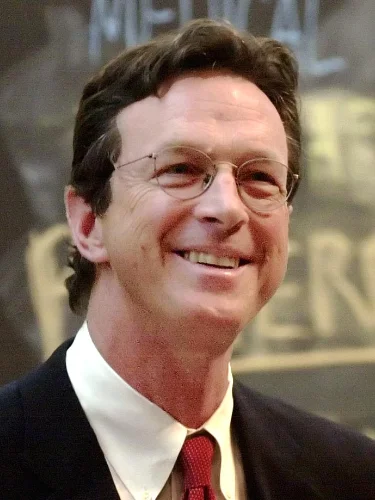
Michael Crichton
A Harvard-trained doctor who never practiced and became a master of the science thriller. He wrote Jurassic Park and The Lost World, directed Westworld and created ER. His books took cutting-edge science, like genetics and nanotech, and asked what happens when it slips out of control. He sold millions and was adapted constantly.
Biography
John Michael Crichton was born on October 23, 1942, in Chicago. He graduated summa cum laude from Harvard in 1964 and went on to Harvard Medical School, earning his MD in 1969. He never practiced. At six foot nine he was hard to miss, but what really stood out was how fast he wrote while still in school.
His first books came out under pen names. As John Lange he put out paperback thrillers starting with Odds On in 1966. As Jeffery Hudson he released A Case of Need (1968), a medical mystery that won the Edgar Award for Best Novel in 1969. With his brother Douglas he wrote Dealing as Michael Douglas. His real name finally hit a cover with The Andromeda Strain in 1969, about scientists racing to contain a microbe from space. It became a bestseller and set his signature: real science, tight deadlines and people running out of time.
Crichton wanted to be behind the camera too. He wrote and directed Westworld (1973), about a robot theme park gone wrong, the first feature film to use 2D computer-generated imagery. He followed it with Coma (1978) and The First Great Train Robbery (1978), adapted from his own 1975 novel about a heist in Victorian England. The idea of a park slipping out of control stayed with him for a long time.
It came back big in Jurassic Park in 1990: a billionaire clones dinosaurs from ancient DNA and builds a park on an island off Costa Rica. The book blended genetics, chaos theory and horror, and Steven Spielberg brought it to the screen in 1993, launching one of Hollywood's most lucrative franchises. Crichton wrote the sequel, The Lost World, in 1995, which was filmed as well. Through the nineties the hits kept coming: Rising Sun (1992), Disclosure (1994), Timeline (1999), nearly all of them adapted for the screen.
On TV he created ER, the emergency room drama that ran from 1994 to 2009, with him as an executive producer. The show won a Peabody in 1994 and the Emmy for Outstanding Drama Series in 1996. Around the same time he received a technical award from the Academy of Motion Picture Arts and Sciences, in 1994, a rare honor for a novelist.
His method was a researcher's: read deeply on a cutting-edge field, build a plausible setup, then ask what happens when it all breaks. Nanotech in Prey (2002), genetic engineering in Next (2006), climate in State of Fear (2004). That last one drew debate for how it handled global warming, and Crichton argued his views in talks and interviews.
Crichton died on November 4, 2008, in Los Angeles, at 66, of lymphoma that had not been made public. More books followed: Pirate Latitudes, found on his computer and published in 2009; Micro, finished by Richard Preston and released in 2011; and Dragon Teeth, written in 1974 and published in 2017. His dinosaurs are still on screens today.
Books, in publication order
- 1968A Case of Need
A Boston pathologist digs into a young woman's death after an illegal abortion. Amazon - 1969
- 1975
- 1980
- 1987
- 1990
- 1992
- 1994
- 1995
- 1999
- 2002
- 2004
Awards
- Edgar Award for Best Novel · 1969
A Case of Need - Academy Award for Technical Achievement · 1994
- George Foster Peabody Award · 1994
ER - Primetime Emmy Award for Outstanding Drama Series · 1996
ER
More authors
Photo: Jon Chase photo/Harvard News Office / CC BY-SA 3.0 via Wikimedia Commons
Sources: en.wikipedia.org · commons.wikimedia.org
Original text by Sagaspedia. Posters: The Movie Database (TMDB); character photos via Wikipedia. This site uses the TMDB API but is not endorsed or certified by TMDB. All trademarks and titles mentioned belong to their respective owners. Streaming availability may change.
As an Amazon Associate, Sagaspedia earns from qualifying purchases.
About · Contact · Privacy · [email protected]