 Sagaspedia
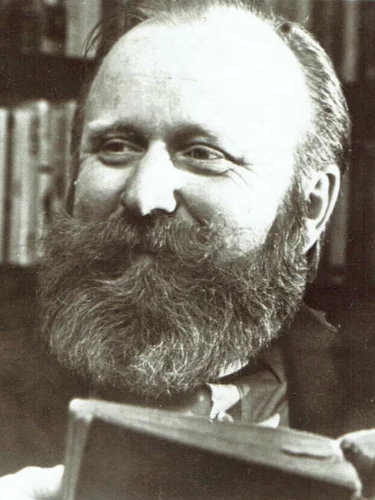
Frank Herbert
A Pacific Northwest newspaperman who spent six years building Dune, a novel turned down by nearly twenty publishers. Released in 1965, it won the Nebula and the Hugo, got five sequels from his own hand and became the basis for films, series and a whole strand of science fiction that mixes ecology, religion and politics.
Biography
Franklin Patrick Herbert Jr. was born on October 8, 1920, in Tacoma, Washington. He grew up in the Pacific Northwest, among forests, rivers and a damp coastline he always watched with a reporter's eye. In 1938 he left home with his little sister and moved in with an aunt and uncle in Salem, Oregon, where he finished high school. He later attended the University of Washington but never earned a degree.
Before he was a novelist, Herbert was a newspaperman for more than three decades. He landed his first job at the Glendale Star in 1939 by lying about his age, then moved to the Oregon Statesman, where he also shot photos. In World War II he served as a photographer with the Navy Seabees and got a medical discharge in 1942. Then it was back to the newsroom: the Oregon Journal, the Seattle Star, the Santa Rosa Press-Democrat and about ten years at California Living, the San Francisco Examiner's magazine. From 1969 to 1972 he covered education for the Seattle Post-Intelligencer. He wrote fiction on the side, and his first novel, The Dragon in the Sea, ran as a magazine serial in 1955.
Dune grew out of a story he never filed. Herbert was assigned a piece on the Oregon Dunes near Florence, where the government was using plants to hold back the sand. He gathered far more material than any article needed and spent years turning it over: desert, water as wealth, religion, power. He started his research in 1959 and took about six years to finish the book. Analog magazine ran it in two parts, Dune World in 1963 and Prophet of Dune in 1965.
Finding a publisher was the hard part. Close to twenty houses turned it down as too long and too odd. The one who said yes was Sterling E. Lanier at Chilton Books, a company best known for auto repair manuals, with a $7,500 advance. Herbert rewrote much of the text, and Dune hit shelves in 1965. It won the first Nebula Award for Best Novel and, in 1966, shared the Hugo with Roger Zelazny's ...And Call Me Conrad. Over time it became required reading for anyone into science fiction.
What sets Herbert apart is how he stacks ideas. Dune is a desert adventure, but it is also a study of ecology, of religion as a political tool and of the danger in following a charismatic leader. He was one of the first genre writers to put ecology and systems thinking at the heart of a story, and the Fremen way of life owes a lot to what he saw on the Oregon coast. He went back to that universe five times: Dune Messiah (1969), Children of Dune (1976), God Emperor of Dune (1981), Heretics of Dune (1984) and Chapterhouse: Dune (1985). Away from Arrakis, he wrote books like Destination: Void, The Dosadi Experiment and The White Plague.
He married three times and had three children. His second wife, Beverly, died in 1984, and the following year he married Theresa Shackelford. Herbert died on February 11, 1986, in Madison, Wisconsin, at 65, of a pulmonary embolism while recovering from surgery for pancreatic cancer.
Dune kept going after him. David Lynch brought it to theaters in 1984, the Sci Fi Channel made two miniseries, in 2000 and 2003, and Denis Villeneuve directed Dune (2021) and Dune: Part Two (2024). On the page, his son Brian Herbert and Kevin J. Anderson carry the saga forward from Frank's notes, with prequel trilogies such as the one that opens with Dune: House Atreides and two novels that wrap up the main line based on his outline for a seventh book.
Books, in publication order
Awards
- Nebula Award for Best Novel · 1965
Dune - Hugo Award for Best Novel · 1966
Dune
More authors
Photo: Unknown photographer / Public domain via Wikimedia Commons
Sources: en.wikipedia.org · commons.wikimedia.org
Original text by Sagaspedia. Posters: The Movie Database (TMDB); character photos via Wikipedia. This site uses the TMDB API but is not endorsed or certified by TMDB. All trademarks and titles mentioned belong to their respective owners. Streaming availability may change.
As an Amazon Associate, Sagaspedia earns from qualifying purchases.
About · Contact · Privacy · [email protected]