 Sagaspedia
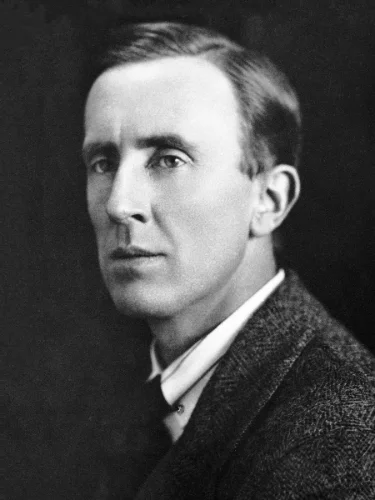
J. R. R. Tolkien
Oxford professor and British philologist who invented languages and then a world for them. He wrote The Hobbit and The Lord of the Rings, which set the template for modern fantasy. He died in 1973, and his son Christopher published The Silmarillion and other Middle-earth legends.
Biography
John Ronald Reuel Tolkien was born on January 3, 1892, in Bloemfontein, capital of what was then the Orange Free State, now part of South Africa. His father, a bank manager, died when he was about three, and his mother, Mabel, had already taken her two boys to the Birmingham area in England. They lived in Sarehole, a village of fields and a mill that stayed with him for life. Mabel died in 1904, when he was 12, leaving Tolkien and his brother Hilary in the care of Father Francis Morgan of the Birmingham Oratory.
He went to King Edward's School and entered Exeter College, Oxford, in 1911. He started in classics, switched to English language and literature and graduated with first-class honours in 1915. Since his teens he had been inventing languages. That hobby produced Quenya and Sindarin, the Elvish tongues, and much of Middle-earth grew out of the need to give those languages a home and a history.
In March 1916 he married Edith Bratt, his teenage sweetheart, and within months he was on the Somme as an officer in the Lancashire Fusiliers. He caught trench fever in October and was sent home in November. While recovering, he began shaping the first legends of the mythology he would work on for the rest of his life. The couple had four children: John, Michael, Christopher and Priscilla.
After the war, his first job was on the Oxford English Dictionary, working on words starting with W. In 1920 he moved to the University of Leeds and became a professor there in 1924. The next year he returned to Oxford as professor of Anglo-Saxon, and from 1945 he held the Merton chair of English Language and Literature until he retired in 1959. At Oxford he was part of the Inklings, an informal circle of writers who read their work aloud to each other. His closest friend in the group was C. S. Lewis, who nominated him for the Nobel Prize in Literature in 1961.
The Hobbit began as a story for his children. In 1936 the manuscript reached Susan Dagnall at George Allen & Unwin, and the book came out in 1937. Its success led the publisher to ask for a sequel. That took more than ten years and grew into something much bigger: The Lord of the Rings, published in three volumes in 1954 and 1955. The setup is easy to pitch. A hobbit inherits a ring the Dark Lord wants back, and someone has to carry it far away. The book won the International Fantasy Award in 1957, became a campus phenomenon in the US in the 1960s and set the template for modern fantasy, with maps, languages, family trees and thousands of years of history behind every scene. In 1972 he was made a Commander of the Order of the British Empire.
Edith died in 1971, and Tolkien died on September 2, 1973, in Bournemouth. His son Christopher took over his father's papers and assembled The Silmarillion, published in 1977, with the legends of the Elder Days. Unfinished Tales followed in 1980, then the History of Middle-earth series and full-length versions of The Children of Húrin (2007), Beren and Lúthien (2017) and The Fall of Gondolin (2018).
On screen, Ralph Bakshi made an animated film in 1978 that covered only the first half of the story, and Rankin-Bass brought The Hobbit and The Return of the King to TV. The big shift came with Peter Jackson's trilogy from 2001 to 2003, followed by three Hobbit films from 2012 to 2014. Amazon bought the TV rights in 2017 and launched The Rings of Power in 2022.
Books, in publication order
- 1937The Hobbit
Bilbo Baggins leaves home with thirteen dwarves to reclaim a treasure guarded by a dragon. Amazon - 1954The Fellowship of the Ring
Frodo inherits the One Ring and leaves the Shire with an unlikely company. Amazon - 1954
- 1955
- 1977The Silmarillion
The legends of the Elder Days, from the making of the world to the wars over the Silmarils. Amazon - 1980
- 2007The Children of Húrin
The tragic tale of Túrin, in the full version assembled by Christopher Tolkien. Amazon - 2017
- 2018
Awards
- International Fantasy Award · 1957
The Lord of the Rings - Commander of the Order of the British Empire (CBE) · 1972
More authors
Sources: en.wikipedia.org
Original text by Sagaspedia. Posters: The Movie Database (TMDB); character photos via Wikipedia. This site uses the TMDB API but is not endorsed or certified by TMDB. All trademarks and titles mentioned belong to their respective owners. Streaming availability may change.
As an Amazon Associate, Sagaspedia earns from qualifying purchases.
About · Contact · Privacy · [email protected]