 Sagaspedia
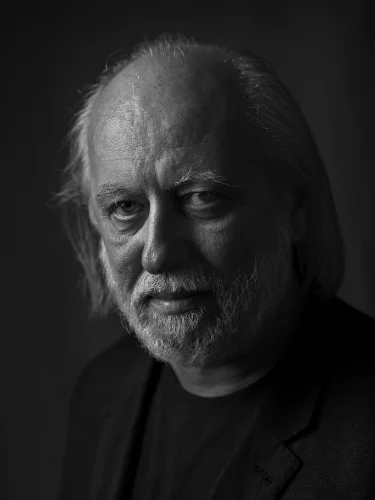
László Krasznahorkai
Hungarian novelist born in Gyula in 1954, famous for sentences that run across whole pages without a full stop. He debuted with Satantango in 1985 and became a regular partner of filmmaker Béla Tarr, who brought several of his books to the screen. He won the Man Booker International in 2015 and the Nobel Prize in Literature in 2025.
Biography
László Krasznahorkai was born on January 5, 1954, in Gyula, a small town in eastern Hungary near the Romanian border. His father was a lawyer and his mother worked in social security. In high school he studied Latin and played piano in jazz bands. He tried law school twice, dropped out, and graduated in Hungarian literature from Eötvös Loránd University in Budapest in 1983, with a thesis on the writer Sándor Márai. His first short story ran in a magazine in 1977.
His first book, in 1985, already showed who he was. Satantango is set on a collective farm that is falling apart, where the locals hear that a man they thought was dead is coming back. Its twelve chapters step forward and then back, like a tango. And the sentences never stop: long blocks with no paragraph breaks that pull the reader along like a current. That became the Krasznahorkai voice.
Film came early. Director Béla Tarr, a close friend, worked with him on several movies. Satantango became a film of more than seven hours in 1994. The Melancholy of Resistance, from 1989, turned into Werckmeister Harmonies in 2000. The partnership ended with The Turin Horse in 2011, which the writer said would be their last project together.
After the fall of the Eastern Bloc he started traveling. He spent a year in West Berlin in 1987, went to Mongolia and China in 1990 and lived for stretches in Kyoto. East Asian aesthetics changed his writing, and Seiobo There Below, from 2008, is the best picture of that phase. While writing War and War, from 1999, he even stayed at Allen Ginsberg's apartment in New York.
In English his books arrived through translators George Szirtes and Ottilie Mulzet. Susan Sontag called him the Hungarian master of the apocalypse. In 2015 he became the first Hungarian to win the Man Booker International. In 2019 Baron Wenckheim's Homecoming took the National Book Award for Translated Literature in the United States.
The Nobel came in October 2025, with the Swedish Academy praising work that reaffirms the power of art in the midst of apocalyptic terror. He is the second Hungarian laureate, after Imre Kertész. In Brazil, Companhia das Letras published Sátántangó in 2022, translated by Paulo Schiller, and announced O retorno do Barão Wenckheim and Herscht 07769.
Award-winning work
- Satantango · Nobel in Literature 2025
Books, in publication order
- 1985
- 1986
- 1989The Melancholy of Resistance
A circus with a giant whale rolls into a town on the edge of chaos. Amazon - 1999
- 2003A Mountain to the North, a Lake to the South, Paths to the West, a River to the East
A short novel set in a monastery near Kyoto. Amazon - 2004Destruction and Sorrow Beneath the Heavens
A travel account through China looking for what is left of its classical culture. Amazon - 2008
- 2009
- 2013
- 2016
- 2019
- 2021
Awards
- Nobel Prize in Literature · 2025
Satantango - Man Booker International Prize · 2015
- National Book Award for Translated Literature · 2019
Baron Wenckheim's Homecoming - Kossuth Prize · 2004
- Best Translated Book Award · 2013
Satantango - Best Translated Book Award · 2014
Seiobo There Below - Austrian State Prize for European Literature · 2021
- Formentor Prize · 2024
More authors
Photo: Miklós Déri / CC BY-SA 4.0 via Wikimedia Commons
Sources: en.wikipedia.org · publishnews.com.br · elcaribe.com.do
Original text by Sagaspedia. Posters: The Movie Database (TMDB); character photos via Wikipedia. This site uses the TMDB API but is not endorsed or certified by TMDB. All trademarks and titles mentioned belong to their respective owners. Streaming availability may change.
As an Amazon Associate, Sagaspedia earns from qualifying purchases.
About · Contact · Privacy · [email protected]