 Sagaspedia
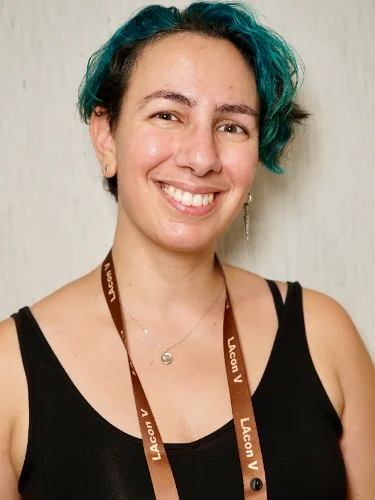
Amal El-Mohtar
Amal El-Mohtar is a Canadian poet, short story writer and critic of Lebanese descent. She broke through worldwide with This Is How You Lose the Time War, co-written with Max Gladstone, and won the Hugo again in 2026 with The River Has Roots, her first solo novella. She also writes the science fiction and fantasy column for The New York Times Book Review.
Biography
Amal El-Mohtar was born on December 13, 1984, in Ottawa, Canada, to a family of Lebanese descent. At six she spent two years in Lebanon. That's where she fell for fantasy and science fiction, thanks to a cousin who introduced her to Doctor Who, and where she wrote her first poem.
Poetry came before prose. Since 2006 she has edited Goblin Fruit, a magazine of fantastical poetry. She won the Rhysling Award, the top prize for speculative poetry, in 2009, 2011 and 2014. In 2010 she published The Honey Month, a collection of short pieces.
Her short fiction caught on fast. "Seasons of Glass and Iron," which brings together two fairy-tale heroines, won the Nebula, the Hugo and the Locus.
In 2019 came the book that reached a wide audience: This Is How You Lose the Time War, co-written with Max Gladstone. Two agents on opposite sides of a war fought across time start writing each other letters. The novella won the Hugo, the Nebula, the Locus and the BSFA, and that same year it was optioned for television, with both authors set to write the scripts.
She is a critic too. Since 2018 she has written the science fiction and fantasy column for The New York Times Book Review, taking over from N. K. Jemisin. She hosted a season of the Writing Excuses podcast and teaches creative writing at the University of Ottawa.
The River Has Roots (2025), her first solo novella, is a fairy tale about two sisters who sing to a magic river. It won the Nebula and, in 2026, the Hugo for Best Novella. That same year saw Seasons of Glass & Iron, a collection of her stories. She splits her time between Ottawa and Glasgow. Her prose reads like poetry, full of letters, songs and echoes of folklore.
Award-winning work
- The River Has Roots · Hugo 2026
Books, in publication order
- 2010
- 2019This Is How You Lose the Time War
With Max Gladstone. Two enemy agents in a war across time start exchanging letters. Amazon - 2025The River Has Roots
Two sisters sing to the magic river between their town and the land of the fae, until one sister's love life gets in the way. Amazon - 2026
Awards
- Rhysling Award for Best Short Poem · 2009
Songs to an Ancient City - Nebula Award for Best Short Story · 2016
Seasons of Glass and Iron - Hugo Award for Best Short Story · 2017
Seasons of Glass and Iron - Nebula Award for Best Novella · 2019
This Is How You Lose the Time War - Hugo Award for Best Novella · 2020
This Is How You Lose the Time War - Locus Award for Best Novella · 2020
This Is How You Lose the Time War - Hugo Award for Best Novella · 2026
The River Has Roots
More authors
Photo: Xuthoria / CC BY-SA 4.0 via Wikimedia Commons
Sources: en.wikipedia.org · kirkusreviews.com
Original text by Sagaspedia. Posters: The Movie Database (TMDB); character photos via Wikipedia. This site uses the TMDB API but is not endorsed or certified by TMDB. All trademarks and titles mentioned belong to their respective owners. Streaming availability may change.
As an Amazon Associate, Sagaspedia earns from qualifying purchases.
About · Contact · Privacy · [email protected]